There are things you stop noticing because you’ve been doing them for so long — the shift of a baby to your hip, the calibration of folding a stroller one-handed. You stop noticing because acknowledging it means opening a door that’s very hard to close.
For twenty-six months — through my second pregnancy and the six months since my daughter Emma was born — I had been quietly not noticing that I was the one who got up at two a.m., tracked the pediatric appointments, remembered which formula Emma tolerated, and handled every piece of the household’s administration by default.
Then my seven-year-old son picked up a microphone on a cruise ship and opened that door for me.
The Back Pain
My husband, Ryan, had always had occasional back issues from years at a desk job. That part was real. What I started to doubt was the timing — how consistently it flared up right when Emma needed to be lifted.
The pediatrician had cleared Emma for normal carrying at her two-month appointment, with Ryan present to hear it. The following week, when I asked him to hold her while I made dinner, he winced and said the doctor had told him to avoid lifting.
I called the pediatrician’s office the next day, not suspiciously — just to confirm the restriction. The nurse checked his chart: there were none on file.
I sat with that. Then, because opening that conversation felt impossible with a newborn, a six-year-old, and a job to return to, I put it away and kept going.
The Cruise
Ryan’s parents invited the whole family on a five-day Caribbean cruise to celebrate their fortieth anniversary. I almost said no — a cruise with a six-month-old sounded exhausting — but Ryan was enthusiastic, and I went.
Boarding day looked like every day had for months: Emma in the carrier against my chest, the diaper bag on my shoulder, our seven-year-old Mason pulling the stroller because Ryan’s hands were, somehow, always full of just his own backpack.
“Can you take Emma? My shoulder—” I asked at one point.
He winced, right on cue. “Claire, please, don’t start.”
I redistributed her to my other hip and kept walking.
What Happened Near the Elevators
In the ship’s crowded atrium, I saw a woman in a white dress whose suitcase had tipped over, clearly heavy and awkward. Several people walked past her.
Ryan didn’t.
He hurried over, lifted her suitcase with both hands, and carried it to the elevator like it weighed nothing.
“Oh my God, you’re my hero,” she said.
He smiled — genuinely, easily. I stood eight feet away, Emma on my hip, and felt three months of suspicion collapse into certainty.
Mason, holding my hand, tightened his grip. “Mom,” he said. “I thought Dad’s back was bad.”
Ryan came over, already defensive. “It was just for a second. Don’t make this into something.”
The Microphone
Nearby, a sail-away party was in full swing, and a cruise host had just finished a welcome speech, leaving the microphone on its stand.
Mason looked at the microphone. Then at his father. Then he slipped his hand from mine, ran to the stage, and grabbed it.
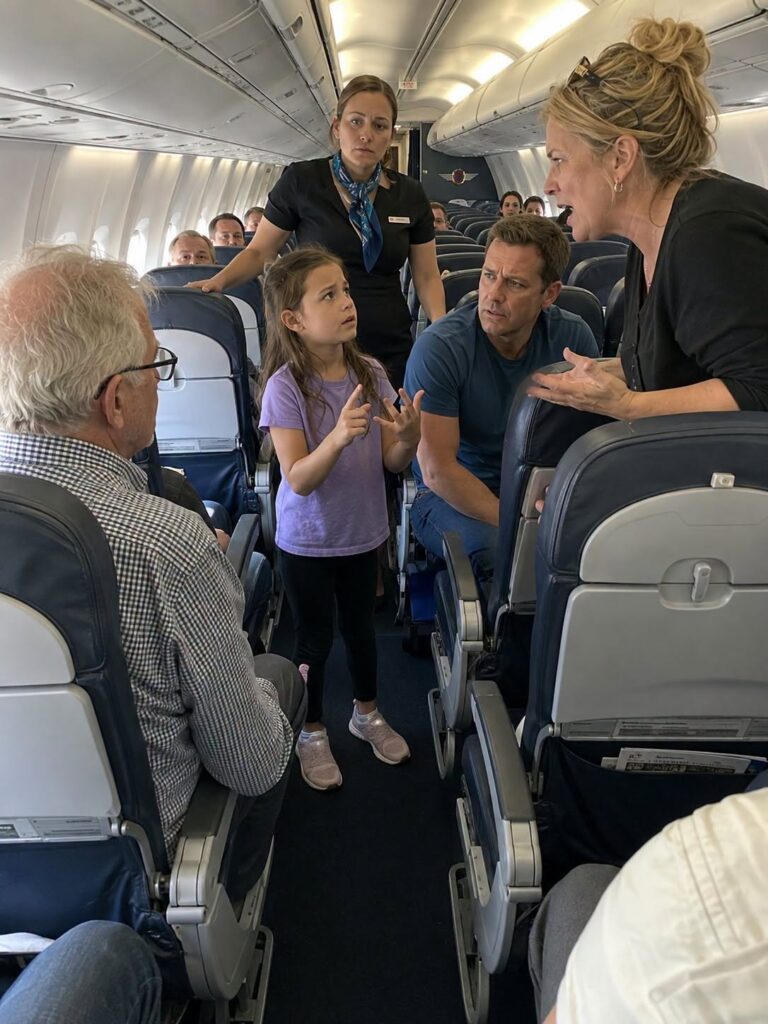
“That’s my dad,” he announced to the whole deck, “and he told my mom his back hurt too much to carry my baby sister, but he just carried that lady’s suitcase, and my mom has been doing everything for months, and I don’t think that’s fair.”
The deck went quiet for a moment — and then someone started clapping. Not mockingly. Genuinely, spreading through the crowd, the recognition of something true said plainly.
Ryan’s mother, Barbara, arrived in time to hear all of it. She looked at her son. “Give Claire the baby,” she said. “Take Emma and go sit down. Give your wife a few minutes without something in her arms.”
He took her — easily, with no wince at all.
What Barbara Said
Barbara sat with me by the railing and took the diaper bag off my shoulder herself. “How long?” she asked.
“Three months,” I said. “The back thing. Longer than that, in terms of how things have really been.”
She offered to take the kids that night so Ryan and I could talk. When I told her I didn’t know if I wanted to, that I was just tired, she said simply: “You’re allowed to be tired.”
It was such a small thing to hear, and I hadn’t let myself hear it in months.
The Conversation
Ryan found me on deck that evening, once the ship had left port.
“Is it real?” I asked. “The back.”
“I’ve had back pain for years,” he said. “That’s real. But not at the level I said. Not for the last few months.”
“Why?”
He was quiet a long time before answering honestly: after Emma arrived, he’d felt increasingly unnecessary — I’d adapted so fast, and he felt like he was in the way more than helping. When his back genuinely hurt for one week, he leaned on it as an excuse rather than admit he felt like he was failing.
“So you stopped helping because you didn’t feel necessary,” I said. “And then I had to do everything, which made me feel like the help instead of your partner.”
“Yes. When you say it like that.”
I told him what I actually needed: for him to help without conditions, to take Emma without a wince, to get up at two a.m. without me having to ask.
“Okay,” he said, immediately, both times.
That Night
Barbara took both kids so we could have an evening. I put Emma down, and Ryan sat with me while I fed her — really present, for the first time in a while.
“I’m going to get up with her tonight,” he said. “However many times she wakes up.”
“Your back?” I asked.
“My back is fine,” he said. It was the most honest thing he’d said in three months.
I slept eight and a half hours straight — something I hadn’t done since before Emma was born. In the morning, I found Ryan in the armchair with Emma on his lap, having gotten up with her twice overnight without complaint.
The Rest of the Trip
It wasn’t an overnight fix. Over the remaining days, Ryan carried Emma up stairs, across the pier, through a beach market. He got up with her again on the second and third nights. There was one slip — reaching for his phone instead of her when she fussed — but when I said his name, he put the phone down and took her. No wince. No back.
Mason had his own reckoning with what he’d done, oscillating between pride and uncertainty. “You’re not in trouble,” I told him on the third day. “You said something true. In the future, there might be a smaller way to say true things — like telling me in private.”
“I wanted someone to know,” he said simply. “I’d been watching it for a long time.”
At his grandparents’ anniversary dinner, Jerry — Ryan’s father — gave a toast: “Marriage is not a thing you have. It’s a thing you do. Every day. Some days you do it badly, and the doing badly doesn’t end it any more than one good day saves it. It’s all of it together.” Across the table, Ryan held a sleeping Emma against his shoulder, and looked at me. We weren’t fixed. But we were still at the table.
After the Cruise
We started couples counseling that September. In our first session, when asked what we each wanted, Ryan said he wanted to feel more present; I said I wanted to stop carrying things alone. Our therapist pointed out those were the same want, from different angles — he wanted to be needed, I wanted to not be the only one doing the needing.
Months later, when Emma learned to pull herself up on furniture, Ryan realized he’d missed watching her practice it for days — an honest moment of recognizing he still had work to do on paying attention, which he said plainly, without defensiveness, in front of both kids.
There’s a photograph from that trip I still keep — not a posed one, but one Mason took candidly at a beach market, of me looking at a piece of fabric while Ryan, beside me holding Emma, is looking at me instead. He didn’t know the photo was being taken. It’s the kind of photograph that catches something real: that even in the middle of the lie, the cruise, the microphone, he was still looking at me that way.
Emma took her first steps that February — four steps toward Ryan, who caught her on the second attempt. Mason filmed it. We’ve watched it more times than I can count.
Some doors are worth opening, even when what’s behind them is hard. Especially then.