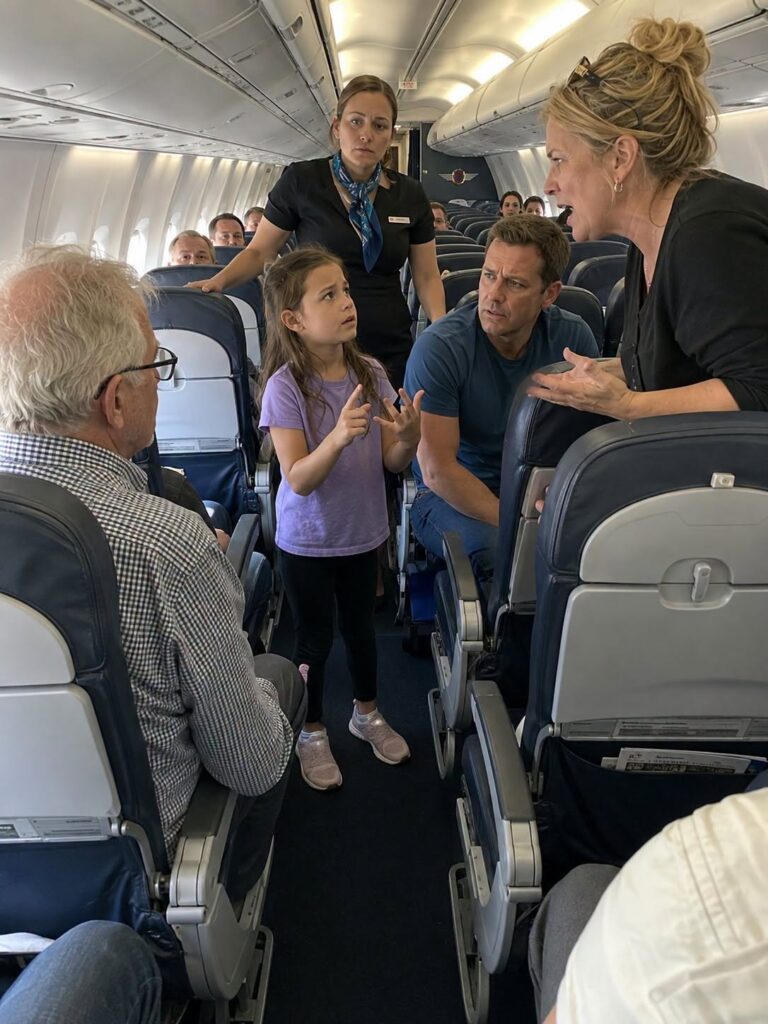
“He cries when he brushes it.”
She was nine, standing in a school corridor in a blue concert dress with a paper star pinned to her chest, her hands in fists at her sides.
“I asked him to cut it,” she said, “and he said we have to wait until I’m seventeen.”
Nobody moved. Twelve of us were crowded into the hallway outside the auditorium with coats, phones, and grocery-store bouquets, and you could hear the radiator ticking under the window. Her father, who had stood so straight a moment earlier, put one hand on the window sill as if he needed it to hold him up.
I’m a hairdresser. I should have been the first to understand. I was the last.
The Girl with the Longest Hair
My daughter Ivy has been in Goldie Moss’s class since first grade. Everyone at Lincoln Elementary knows Goldie, not because she’s loud, but because of her hair. It reaches past her knees, dark honey that looks almost red in the sun. In fifteen years of cutting hair, I’ve never seen anything like it on a child.
Nor have I seen a father like hers. Daniel Moss, a machinist, arrives early to every school event straight from work, with gray dust on his knees. He brings a small round mirror, sets a plastic chair by the hallway window, and braids: French braids, crown braids, ribbons woven in to match her dress. It takes forty minutes, and not one strand ever comes loose. I’ve checked. It’s a professional habit.
The other parents melt. “Real men braid,” one grandmother captioned a photo online.
But I saw what they didn’t. Goldie’s braid caught on her chair, and she winced and sat on the edge of her seat for the rest of the hour. In gym she held it in one fist and couldn’t do cartwheels. In the cafeteria she ate a whole sandwich with one hand holding her hair to her chest.
“It’s weird, right?” I told my husband, Brian, that night.
“Meg,” he said, “it’s not your kid.”
He was right. I said nothing, to Goldie or to Daniel. I just watched and judged from a polite distance, which I’ve since learned may be the worst way to do it.
The Hallway
On the night of the winter concert, Ivy had a solo and had been so nervous she’d thrown up that morning. The auditorium doors were delayed, so we waited in the hallway.
Daniel combed Goldie’s hair out section by section, holding each in his fist so it wouldn’t pull, the correct way, which most parents never learn. When he finished, Goldie hugged him and ran off holding her braid.
That’s when Denise Harper said, loudly, “Somebody should have taken that child to a real hairdresser years ago.”
“We manage,” Daniel said quietly.
Trish Keller added, “That’s not devotion anymore. That’s something else.” Then Mrs. Holloway, softly: “Maybe you’re the one who can’t let go of something. And she’s the one paying for it.”
Daniel turned, and his face wasn’t angry. It looked like a thread had been pulled loose inside him.
Goldie had come back. She walked between him and all of us and said, in a shaking voice, “Don’t talk to my dad like that.”
Then quieter: “He cries when he brushes it. Every night. He thinks I don’t see, but I see him in the mirror. I asked him to cut it, and he said we have to wait until I’m seventeen.”
Daniel gripped the sill with his head down. “I’m sorry, Daddy,” she whispered. “I wasn’t supposed to say.”
“You didn’t do anything wrong, bug,” he said, his voice cracked.
The doors opened, and everyone drifted in without looking at each other. Ivy sang her solo, her voice cracked on the high note, and she kept going. In the back row, Daniel watched only his daughter.
The Comic Book
“Can Goldie come over?” Ivy asked afterward. “She’s my best friend. I told you like a million times.”
I hadn’t been listening. I’d been too busy watching the hair.
I texted Daniel, rewriting it eleven times. Two days later, one word: Okay. He dropped her off on Saturday in a clean flannel shirt and stayed on the step. “Those women weren’t wrong about how it looks,” he said. “I know how it looks.”
The girls spent the afternoon drawing a comic book. Goldie was louder and funnier at my house, and she did a perfect impression of her teacher. But her braid kept swinging into the marker, and finally she tucked it into her waistband like a tail.
“It was my mom’s idea,” she said quietly. “She had hair like this. She could sit on it. She died when I was four.”
The Promise
When Daniel came back, we sat on my cold back porch with coffee he didn’t drink.
“Her name was Lena,” he said. “She sat in front of me in chemistry, and her hair hung over my desk. I braided it just to keep it out of my way. She didn’t even know. When she caught me, she laughed and said, ‘Do the other side too, so it’s even.'”
Lena’s family believed a woman’s hair holds her memories. “It’s beautiful and it’s heavy,” she used to say. At seventeen she’d cut hers off to donate to a charity that makes wigs for children with cancer, for her little cousin Maddie. Then she grew it back.
“She got sick when Goldie was two,” he said. He didn’t linger on the illness. “Near the end, she made me promise: ‘Don’t let them cut Goldie’s hair. Let it grow until she’s seventeen. Then she decides.’ I’ve never cut an inch. Not a trim. Goldie’s been asking since she was seven, and every time I say, ‘Mom wanted it that way.’ And she looks at me like I’m choosing her mother over her.”
“And you cry,” I said.
“Every night, I’m brushing Lena’s hair. It’s the same color, the same wave. I didn’t know about the mirror on the closet door. She’s watched me cry for two years and never said a word.”
The Meeting
In January, Goldie’s hair caught in a swing chain on the playground. She wasn’t seriously hurt, but she was scared and sore, and she cried for her dad. He couldn’t be reached at the plant, so the school called me.
When Daniel arrived with his safety glasses still on his head, I watched something change in his face. For the first time, I think he didn’t see Lena’s hair. He saw his little girl, hurt.
The school asked me to sit in on a meeting. The principal asked that Goldie keep her hair pinned up during the day. “It’s too heavy for that,” I said before I could stop myself. “Pinning that much weight up for seven hours could give her headaches.”
The counselor, Ms. Grant, spoke gently. “Goldie told me why she stopped asking you to cut it. She said, ‘When I ask, Daddy gets quiet for the rest of the night. So now I just don’t ask.'”
Daniel walked out. “It’s the only thing I have left,” he said at the door.
I found him in his truck, with a pink elastic on the gearshift and a small mirror on the dashboard.
“She’s nine, and she’s taking care of me,” he said.
“You’re grieving,” I said. “It’s not an excuse. It’s just the truth.”
Then he told me about the letter.
The Letter
Lena had left one for Goldie every birthday until eighteen, and one for Daniel, with an envelope marked For when you’re stuck.
“I haven’t opened it,” he said. “I’m not stuck.” He heard himself, and started to laugh, and then he put his forehead on the steering wheel and cried.
He called me at eleven-thirty that night. “I opened it. I can’t read it out loud.”
The letter, in loopy handwriting, said:
Danny, if you’re reading this, you’re stuck. You’re the only person who’d rather sit in a traffic jam for three hours than take a different road. I know what I asked: seventeen. But I didn’t mean make her wait. I meant make sure she gets to choose. When I was little, my hair wasn’t mine. At seventeen I cut it, and it was the first time I felt it belonged to me. If Goldie asks you to cut it, and she means it, that’s the whole promise. It was never about the hair. It was always about her. And I’m not in her hair, Danny. I’m in her laugh, in the gap in her teeth, in the way she cries at dog food commercials. You don’t have to keep her hair long to keep me. You just have to keep her. Let her choose. Then braid it anyway, as long as she’ll let you. Take a different road once in a while. Love, Lena.
“Five years,” Daniel said. “It’s been in my sock drawer five years.”
A floorboard creaked. Goldie stood in the hallway in horse pajamas, her hair trailing behind her. Daniel knelt and held out his arms.
“Bug, do you still want to cut it?”
“You said seventeen.”
“I was wrong. Mom wrote me a letter. It’s your choice.”
“You’re not going to be sad?”
“A little,” he said. “But I’d rather be a little sad than watch you hold your hair in your fist for the rest of your life.”
The Cut
We did it on a Sunday at my salon after closing, with snow falling outside. Goldie wanted no audience except Ivy, her requested “moral support.” (“It means you hold her hand if she gets scared,” I explained. “Oh,” Ivy said. “I do that anyway.”)
Goldie chose her length: shoulder blades, “so I can still have braids, but it doesn’t get stuck in things.” Then I explained the donation cut. You braid the hair, secure both ends, and cut above the top elastic.
“Would you like to braid it?” I asked Daniel. “It should be yours. The last one.”
He combed it out and made a plain three-strand braid, the first kind anyone learns, the kind a boy might put in a girl’s hair in chemistry class. His hands shook, and he dropped a strand and started over.
“Daddy, you’re crying.”
“It’s okay to cry, bug. Sometimes it just means something’s important.”
She made the first cut. I finished the rest. When the braid came away, he had to hold it draped over both arms.
Goldie shook her head, and her hair swung loose. “It’s so light,” she said in wonder. “Daddy, my head is so light.”
She laughed and cried at once, spun across the salon floor, and did a clumsy, crooked, beautiful cartwheel. “I did it! Ivy, did you see?”
Daniel stood holding four feet of braid and smiling like a man who had come up for air. He clipped one small piece from the oldest end, the hair from when Lena was still alive, and labeled the envelope: G. — age 4. For when you want it.
After
On Monday, Goldie walked down the hallway with her hair loose. “You cut your hair!” someone yelled. “I know,” she said. “I did a cartwheel, too.”
Denise Harper crossed the hall to Daniel. “It looks nice. She looks happy. I didn’t know.”
“You didn’t ask,” Daniel said, not angrily, just true.
“No,” she said. “I didn’t. I’m sorry.”
Later, Mrs. Holloway stood beside him at pickup. “My husband died eleven years ago. I kept his coat on the hook by the door for six years. When I said what I said in that hallway, I wasn’t really saying it to you.”
“I know,” he said.
In May, at the spring concert, he braided Goldie’s hair at the same window in ten minutes. “He wanted fishtails,” she reported. “I said too fancy. I’m the client. The client decides.”
He showed me a thank-you letter from the wig charity, with a note in a child’s wobbly pencil: Dear girl who gave me her hair, my name is Sophie. I am 7. My hair fell out and I cried every day. My new hair came yesterday. It is so long! Nobody called me egg head. Thank you for your hair. When mine grows back maybe I will give it to somebody too.
Goldie had written back to tell her about cartwheels.
“I called Lena’s cousin last week,” Daniel said. “She said, ‘It keeps going. That’s what Lena always said.'”
He sat in the fourth row this time, next to me and Brian. When Goldie waved from the choir, he waved back.
What I Learned
For two years I looked at Goldie and thought I knew exactly what was wrong. I was right about all of it, and I understood none of it.
It was never really about the hair. It was about a promise that got heavier every year no one questioned it. We all carry things like that: promises to people who aren’t here, rules we never read twice, coats on a hook by the door. We carry them because putting them down feels like losing the person again.
But the people who love us don’t want us carrying them forever. Lena wasn’t in the hair. She was in the cartwheel on my salon floor and in a letter to a seven-year-old named Sophie.
Last week Ivy came home from a sleepover with a perfect French braid. “Mr. Moss braided my hair. Then he let us braid his. He had like fifteen tiny ones.” She yawned. “Goldie said he never used to laugh that much. She says it’s because her head’s not so heavy anymore. But I think it’s his head that’s not so heavy anymore.”
“Yeah, baby,” I said. “I know exactly what you mean.”