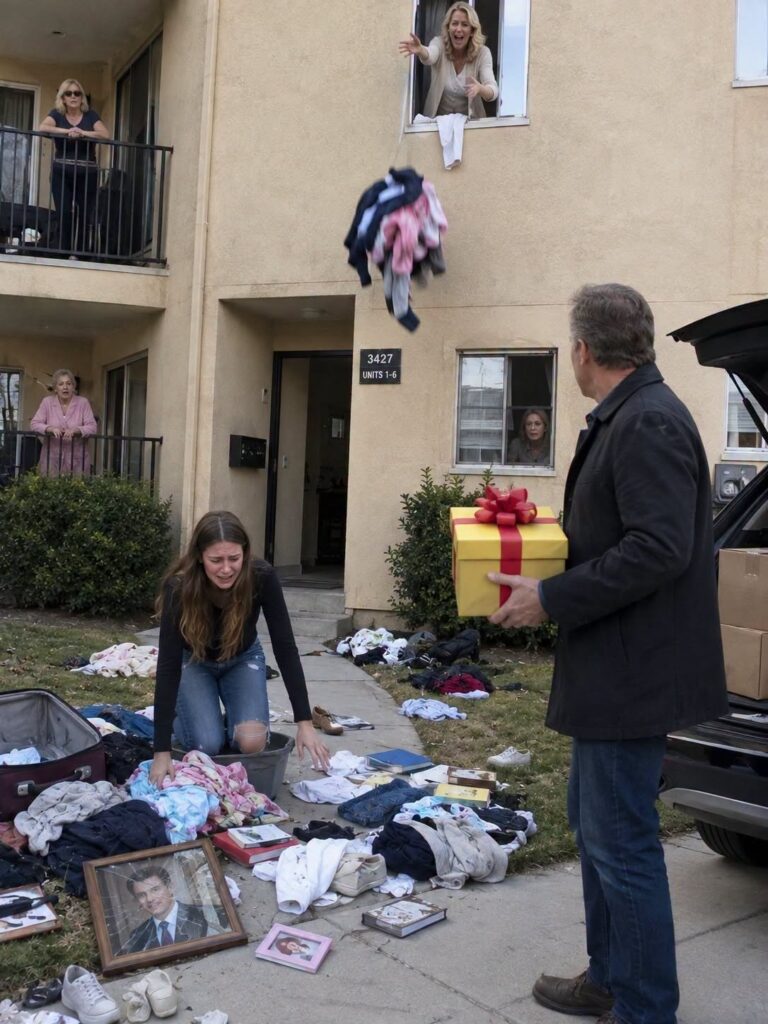
“You owe your brothers a future.”
My mother said it like a verdict. Then she set a folder on my conference table so firmly that it slid across the walnut and stopped against my laptop.
I didn’t touch it. I could see what was inside: tuition schedules for two colleges, printouts marked in yellow highlighter, and at the bottom of the first page, circled twice in blue pen, a number.
$310,000.
I hadn’t heard her voice in three years. Now she stood in my Chicago office, eighteen floors above the river, in a camel coat that cost more than my first car, talking to me as if I were still sixteen.
“They’re not my brothers,” I said.
“They’re your family.”
“So was I.”
She tapped the folder with one manicured nail. Three slow taps. It was the same way she used to tap the kitchen counter when I’d said something she planned to make me regret.
“Evan got into a top university,” she said. “Tyler wants engineering school. You have more money than you could ever spend.”
“That doesn’t make it theirs.”
“After everything I sacrificed raising you.”
I laughed before I could stop myself, short and sharp. Then she leaned forward and lowered her voice, almost kind, like she was handing me a present. She told me what was going to happen at noon.
I’ll explain all of it: the intern, the alert at 2:13 in the morning, the pen, and the small white button under the table’s edge. But none of it makes sense until you understand the trash bags.
The Porch
My dad died when I was eleven. Ten weeks from diagnosis to funeral.
He was a claims adjuster who kept every receipt he ever touched in labeled shoe boxes in the hall closet. When I was eight, I asked why. He tapped a lid marked TAXES 1998 and said, “Because people remember things the way they want to remember them. Paper doesn’t care what you want.”
After he was gone, my mother, Diane, spent two years publicly devastated and privately furious. Sometimes I think she was furious at me for having his eyes and his chin.
Then she met Rick Fletcher, a contractor with a loud truck, a louder laugh, and two little boys. Evan was three and Tyler was barely walking. I want to be clear that those boys never did anything to me. They were babies who liked their pancakes shaped like dinosaurs. Evan would hold up his plate and yell “Stegosaurus!” and Tyler would copy him with “Sauce!”
Hold on to that. I still do.
Mom married Rick six months after their first date. I clapped at the courthouse wedding, hard, because I still thought my job was to be easy to love.
Six months later, I came home from a cross-country meet and found my bedroom furniture on the front lawn, with a sheet of paper taped to the headboard that said FREE.
“Your room is becoming the boys’ playroom,” Mom said, drying her hands on a dish towel. “You’ll be on the pull-out in the den. Temporarily.”
I told myself it was temporary. You’ll hear me say that a lot.
The den had no door. A metal bar in the mattress pressed into my back every night. I didn’t complain, because complaining wasn’t easy to love.
One Friday in October, I came home from my shift to find four black trash bags on the porch. The good kind, with drawstrings. My clothes were inside, and my books, and my dad’s shoe boxes. The porch light was off.
The door opened eight inches and stopped at the chain.
“Mom?”
“You’re old enough to figure things out.”
The door closed. The lock turned.
I stood there doing math, the practical kind. It was 9:40. The last bus left at 10:15. I had sixty-three dollars in tips folded inside my sock, and one friend who lived eleven minutes away if I walked fast.
When Tasha opened her door and saw me with the bags, she did the kindest thing anyone has ever done for me. She asked no questions. She picked up two bags and said, “Okay. So you live here now.”
Her mother, Miss Renee, appeared at the top of the stairs in her bathrobe. “Basement,” Tasha said. Miss Renee nodded once. “I’ll get the sheets.”
She left a towel and a new toothbrush, still in its package, on top of the dryer. When I tried to offer my sixty-three dollars, she held up a hand. “Baby, go to sleep.”
Nobody in that house ever made me perform gratitude. I stayed a year, stocking shelves until midnight and doing trigonometry on the backs of inventory sheets. My mother never called. I know, because I checked every day.
When the Reeves family moved away, I rented a room above a laundromat for $85 a week and finished high school alone. Nobody came to my graduation. I walked anyway.
Two years later my mother mailed me a card with a lighthouse on the front. She didn’t apologize or ask where I lived. She asked me to co-sign a loan for Rick’s new truck, because I had no debts to drag down my credit. I put the card in one of my dad’s shoe boxes and never answered.
The Paper Trail
Here’s what I did instead, in the flattest terms, because this is a receipt story and not a bootstraps fairy tale. I did two years of community college while working full-time. Then I got a job in a hospital’s medical records department, where I found out I loved audit trails. A record could tell you exactly who touched it, when, and why, and it didn’t care who was charming.
I earned my health information certification, which cost $229 to sit for. I ate rice for a month to cover it. At night I built a small, ugly piece of software to close the gap between what people said happened and what the log said happened.
At twenty-four I moved to Chicago. At twenty-five I co-founded a company building audit-trail software for clinical research sites. I sell paranoia with a dashboard, and the market is excellent.
My co-founder was Daniel Reyes, the sales half: warm, older than me, fluent in golf. For three years it worked. Then a client noticed that validation data had been exported outside our system, and their lawyers filed a complaint naming both founders. Daniel told our investors, clients, and employees that the export had been done at my direction.
For nine days my own engineers wouldn’t meet my eyes. Then the forensics came back. The exports had been run under Daniel’s credentials, from his laptop, over his phone hotspot, at 11:52 on a Tuesday night. He’d been negotiating a job with a competitor and wanted to bring a dowry.
He resigned. A settlement followed, along with a protective order sealing the complaint. The first eleven pages named me falsely. Only on page twelve did the truth appear. Only three people knew the whole story: me, Daniel, and my attorney, Naomi Sachs, who reads contracts the way other people read crime novels, hunting for the body.
I rebuilt the company around one principle: never again would there be daylight between what someone claimed and what we could prove. I hired Maya Okafor as compliance director. We adopted least-privilege access, quarterly reviews, and logs on the logs. In the eighteenth-floor conference room, at Naomi’s insistence, we installed a small white button under the table’s edge. One press starts the room’s recording and alerts building security.
“This is theatrical,” I told her.
“Theater is what you call preparation before you need it.”
I thought all that armor was for people like Daniel. I never imagined it was for my mother.
Four Strange Things
The first came on June 12th. A freelance journalist emailed our press inbox asking whether the company had ever resolved litigation involving a former executive. The only public trace of Daniel’s departure was a three-line trade item, five years old. You’d have to be told to dig.
I sent a standard “no comment” and forwarded the email to Maya: Does anything about this smell? She found nothing, but she added view-level alerts on the restricted legal archive, including the sealed folder.
“It costs nothing,” she said. “I’m paid to be paranoid.”
Remember that.
The second came eight days later, from my aunt Carol: So happy to hear you and your mom are finally patching things up! She talks about you constantly. We hadn’t spoken in three years. She’d last called to ask for $40,000 for Rick’s business, and I’d said no. My mother was building a story, and it needed me in it.
The third came on July 1st, when my friend Tasha mentioned that Rick’s construction business was collapsing: liens, lawsuits, a repossessed truck. I waited to feel something and felt nothing. “It’s not my problem,” I said.
But I didn’t ask the next question. Desperation is never just weather. Desperation is motive with a deadline.
The fourth had been sitting in my own building for six weeks. One of our summer interns, a quiet kid in data governance, had asked his supervisor how long we keep old legal files. She was delighted. I felt a small, cold pin of something and let it go. Twice I caught him watching me, and both times he looked away fast. One Friday I put a yellow Post-it on my monitor that said INTERN and told myself I’d look on Monday.
That Post-it was still there the morning my mother walked in. I’ve kept it, a monument to every Monday that never comes.
Noon
She arrived at 8:12 on a Thursday. My assistant messaged me: There’s a Diane Fletcher at the front desk. She says she’s your mother?
I should have had security walk her out. Instead I wrote back, Put her in 18B. That afternoon I had a due diligence call with a nine-hospital alliance, the largest deal in our history. She knew that. She’d chosen the week the way you choose where to put a lever.
Now she was leaning in, whispering.
“Pay the tuition,” she said. “Or at noon, a reporter gets the sealed complaint. The one about how you really built this company.”
The room went very small. Sealed meant sealed. But headlines don’t wait for page twelve.
“How do you know about that?”
She smiled the smile she saves for winning. Then my laptop chimed with an automated alert, the kind Maya had enabled in June.
RESTRICTED LEGAL ARCHIVE — ACCESS EVENT. 2:13 a.m. Username: Evan Mason.
Our quiet intern. Rick’s first wife, the boys’ late mother, had been a Mason, and Evan had taken her name at eighteen. I’d later learn it was the one tender thing in this whole mess: a boy carrying his mother’s name into the world.
Little Evan, who yelled “Stegosaurus!” at his pancakes. Nineteen now, planted in my company by his own family.
“Did you send him here?”
Her eyes flicked toward the door. Just for a second. But I’d spent sixteen years learning her tells the way sailors learn weather.
I could have called security and thrown her out. It would have felt incredible for about an hour. Then I’d have had nothing: a he-said-she-said, a desperate family with a copy of a sealed file, and a teenager left to take the fall alone.
Or I could give my mother the one thing she has never resisted. An audience for her cleverness.
So I let my shoulders drop and looked at the folder like it weighed a hundred pounds. “Walk me through it,” I said quietly.
And she did. She loved it.
While she talked, my hands moved under the table. One text to Maya: Lock the restricted archive. Now. Evan Mason is Diane Fletcher’s stepson. Hold him at the elevators. Be gentle. He’s a kid. One to Naomi: 18B. Now. Bring the Reyes settlement file. And one firm press on the small white button.
My mother talked for eleven minutes. Rick kept a copy on a drive at the house. Evan had been told it was “family research,” that I’d built my company on money that partly belonged to them. The June journalist had been her idea, an anonymous tip to see if the old lawsuit still had teeth.
“I did my homework,” she said.
She had no idea that tip was the domino that made Maya switch on the alerts.
Then she slid a pen across the table, with two pages printed at a public library the day before. An agreement making me responsible for both boys’ tuition for four years, plus an “administrative consideration” for herself, and a line for a notary. “Sign, and this all goes away. We can even have Thanksgiving. Refuse, and you lose everything I let you build.”
Let me build. Her whole math, in one sentence. The porch, the trash bags, and the room above the laundromat were all investments in her ledger.
The door opened. Naomi walked in with a gray litigation box, followed by two security officers who took positions along the wall.
“Good,” my mother said. “Witnesses. They can watch you finally do right by your brothers.”
“You’re right,” I said, and stood. “They can.”
I turned my laptop toward her: Evan’s username, the June alerts, the 2:13 entry, the lockout Maya had executed nineteen minutes earlier. Above it sat the email I’d sent ten minutes ago to Naomi, to our insurer’s counsel, and to the police department’s detective line.
“You gave me until noon, Mom. The police said they’d be here by eleven.”
Renegotiation
She didn’t break. People like my mother don’t shatter. They renegotiate.
First came contempt. A short, social laugh. “You won’t do this. It costs you more than me.”
Then she held up her phone. “One text, and it goes out anyway.”
Naomi spoke for the first time, flat as a grocery list. “That document is sealed under a protective order. Distributing it is contempt of court. And no serious newsroom publishes a sealed filing from an anonymous source without calling the company first. You’ve been holding a grenade with the pin glued in, Mrs. Fletcher.”
Then came the pivot to victim. My mother’s spine softened; her voice turned wounded. “This is a family disagreement. She’s always been so dramatic.” She reached for the folder.
“Leave it,” Naomi said. “That’s evidence now.”
Her hand stopped in the air. For one second I watched her consider taking it anyway, the way she’d once considered a chain lock and a girl doing math in the dark. Then she put her hand in her lap.
My phone buzzed. Maya: He came down at 10:52. He’s with me. He’s shaking. His grandmother is 90 minutes out.
That was the worst moment of the day. Two floors below sat a nineteen-year-old whose adults had spent years telling him that stealing from me was justice, and in minutes real detectives would walk into his life. I was the only person in the building who could decide what that would mean for him. I know what that lesson does to a person at that age.
Detective Marcus Boyd arrived at 10:58, a big, unhurried man with reading glasses pushed up on his head, who looked at the room the way a plumber looks at a flooded kitchen. Fixable. He never raised his voice. Nobody in this story did.
“Mrs. Fletcher, I’m going to need you to step out with me.”
She smoothed her coat. At the door she tried once more, the oldest key to the oldest lock. “After everything I sacrificed.”
I didn’t answer. Sixteen years ago I would have. That morning I just watched her walk past the glass wall, past two dozen employees pretending magnificently to study their monitors. Halfway to the elevators, under the flat hallway light, her posture stopped being marble and turned to chalk.
What Happened Next
I gave Boyd my statement in 40 minutes, in order, with exhibits. My father’s daughter. The folder, the agreement, and the pen went into evidence bags, each logged in front of me. He read my access logs twice. “In twenty years,” he said, “I’ve never had the victim’s own product testify this well.”
Prosecutors approved charges that day. She was released that night under conditions, including no contact with me, with witnesses, or with Evan. It took me a long minute to accept that the woman who’d threatened my company at noon would be home by nine.
Police searched the house in Rockford that evening and found a USB drive in Rick’s desk and a second copy in the console of his last truck. Rick, it turns out, backs things up in one clever place and one stupid one. The reporter at noon? Mostly a drafts folder: two unsent messages and the June tip that had triggered the whole chain. Her opening move was the trip wire that caught her. Naomi says the technical term is discovery.
At 11:40 I went down to see Evan. His badge was already on the table. When I walked in, he stood so fast his chair hit the wall.
“My dad said it was just copying files. He said you stole from the family first. That you owed us—”
He stopped on the word. I watched him hear it in his own mouth for the first time, outside the house it was built in. There’s a particular silence a person makes when the story they were raised in dies in front of them. I know it from the inside.
“You’re nineteen,” I said. “That’s exactly old enough to be used, and exactly young enough to start over. I have personal experience with both halves.”
He told the truth from the first minute, to Maya, to Boyd, to the prosecutor, including the parts that hurt his father. I told the state’s attorney in writing that the adults in his household had directed him, that the company did not want him prosecuted, and that an over-permissioned migration project on our side had given an intern a path into that archive. Evan was never charged. Tyler, seventeen, knew nothing. Those boys lived in that house. They didn’t build it.
At 1:04, four minutes late, I joined the due diligence call. We had disclosed everything to the hospital alliance ourselves. I answered questions for two hours in a voice I barely recognized as mine, while my mother’s folder rode across the Loop in an evidence bag. The deal signed in October.
After
My mother pleaded guilty before trial: probation, a felony record, court costs, and a standing no-contact order. Rick took a reduced plea and probation. Nobody went to prison. “This is what proportionate looks like,” Naomi said, “when no one was hurt and nothing was taken.”
The house in Rockford sold. Aunt Carol sent me one text in August: I don’t know what you did to your mother, but I hope it was worth it. I admired it like a museum piece, a family where my mother’s version is the master record and everyone else is an unauthorized edit. Then I blocked her. Some archives you seal yourself.
In October, a handwritten letter arrived from Evan, clearly folded and unfolded through several drafts. He asked for nothing. He named exactly what he did and why it was wrong, and he wrote that he’d started using Mason full-time, because he wanted a name that hadn’t been used for anything. He now works at a hardware store and lives with his grandmother.
I wrote back once. I told him he was the only person in this story who, upon learning what he was part of, told the truth at his own expense on the first try, and that this is rarer among adults than he has the data to appreciate. I didn’t offer a job, tuition, or a relationship. Some doors you leave unlocked without standing in them.
Every May, a large arrangement of flowers goes to a house in Milwaukee, signed From the girl in the basement. Every May, Miss Renee calls to scold me. “Baby, this is too much.”
“I hear you, Miss Renee.”
Neither of us says the other sentence, the one about what a towel and a toothbrush on top of a dryer can do to the direction of a whole life.
People ask whether I’ve forgiven my mother. What I feel is quieter than forgiveness and sturdier than anger. She sat in my conference room believing she’d raised a girl who could be threatened, because she was never once curious about the person she left on that porch.
She did her homework on my company. She never did it on me.
Sixteen years ago, my mother put everything I owned into four trash bags, turned off the porch light, and told me I was old enough to figure things out.
She was right. I did.