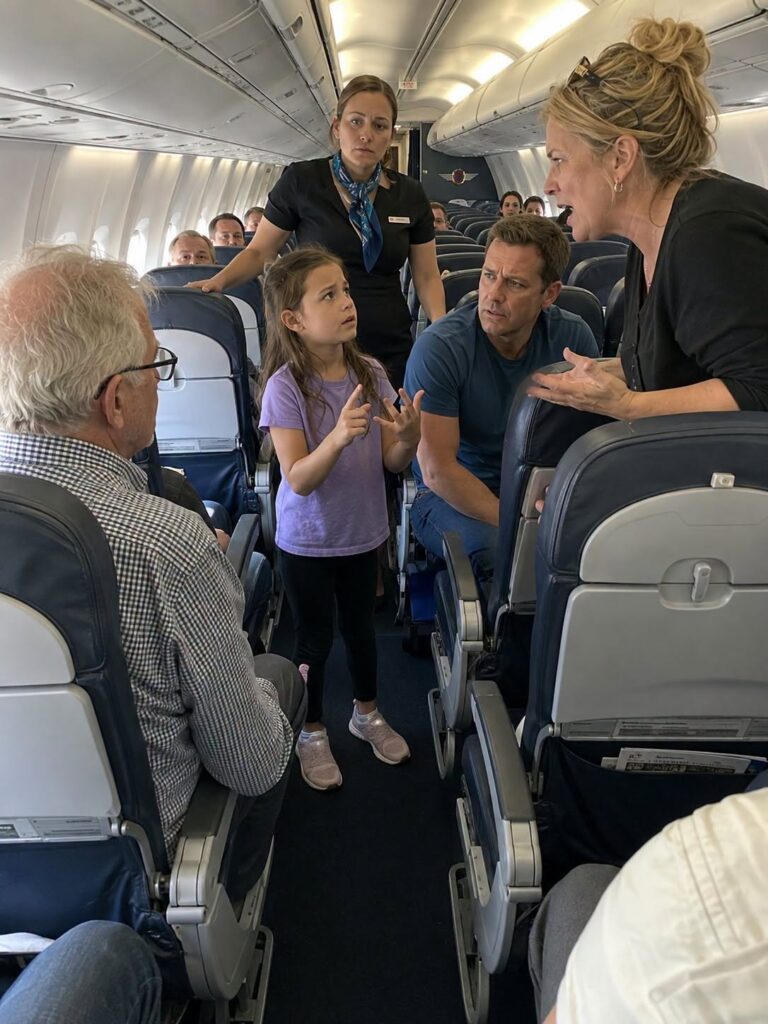
I was flying with my grandmother Beatriz, eighty-six, on a cross-country trip to visit family, and about twenty minutes into the flight, I noticed the woman seated beside her, a passenger named Carol, gradually needing more of the shared armrest and legroom space than the cramped economy seating allowed for without genuinely crowding my grandmother’s already limited room.
I want to be honest that my first instinct, watching this unfold, leaned toward frustration on my grandmother’s behalf — an eighty-six-year-old woman with her own mobility concerns didn’t need less space than an already tight economy seat provided, and I was fully prepared to advocate directly with Carol about the encroachment before I noticed what was actually causing it.
Carol, it turned out, was managing a portable oxygen concentrator, a medical device essential for a respiratory condition that required supplemental oxygen during air travel, and the device itself, along with the tubing connecting it to her, required a certain amount of space around her seat that a standard economy configuration hadn’t been designed to comfortably accommodate.
I flagged the situation to a flight attendant, not to complain about Carol specifically, but because it was clear that neither passenger’s needs were being adequately met by the current seating arrangement, and I suspected the airline might have better options than either of us could work out on our own mid-flight.
The flight attendant, Denise, assessed the situation carefully and thoroughly, checking both Carol’s medical equipment documentation and confirming my grandmother’s own mobility needs, before identifying a solution that addressed both passengers’ actual requirements rather than simply asking one or the other to adjust and hope for the best.
“We’ve got two open seats in a row further back with slightly more legroom, part of our economy-plus section,” Denise explained. “I’d like to move Carol there, since the extra space would genuinely help accommodate her equipment more comfortably, and that would free up considerably more room for your grandmother in this row without either of you needing to simply tolerate a cramped situation for the rest of the flight.”
What struck me about the whole resolution was how genuinely respectful it was toward both passengers’ actual needs, rather than treating the situation as a simple space dispute between two people competing for the same limited resource. Carol’s medical equipment wasn’t framed as an inconvenience to be minimized or apologized for, and my grandmother’s need for adequate space as an older passenger with her own mobility concerns wasn’t dismissed either. Denise found an actual solution that served both needs rather than forcing either passenger to simply accept less than what they genuinely required.
Carol, before moving to her new seat, turned to my grandmother with a warm, genuine apology. “I’m so sorry about the cramped space. This equipment takes up more room than I wish it did, especially in these smaller seats.”
My grandmother, gracious in the specific way people of her generation often are about minor travel inconveniences, waved off the apology entirely. “You do what you need to do to breathe properly, dear. I raised four children in cars with no air conditioning through Texas summers. This was nothing.”
I want to be honest that watching this entire interaction unfold reframed my own initial frustration considerably. My first instinct, before understanding the actual situation, had been to see Carol’s space as an imposition on my grandmother rather than a legitimate medical necessity that neither passenger had any control over, a framing that, in hindsight, would have needlessly pitted two passengers against each other over a seating configuration problem that was actually the airline’s responsibility to solve properly.
The remainder of the flight passed considerably more comfortably for both my grandmother and Carol, once Denise’s solution actually addressed both of their genuine needs rather than leaving either of them to simply manage an inadequate situation independently.
I wrote a detailed note to the airline afterward, not a complaint, but specific praise for how thoughtfully and respectfully Denise had handled a situation that could have easily become an uncomfortable standoff between two passengers if handled with less care and attention to what was actually happening for each of them.
What I took from that flight, more than any specific detail about my grandmother’s trip, was a clearer appreciation for how quickly an accidental space conflict between two passengers, each managing entirely legitimate needs, could either escalate into unnecessary tension or resolve smoothly into a solution that respected both people fully — the difference, in this case, coming down entirely to a flight attendant who took the time to actually understand what each passenger genuinely required before assuming either one simply needed to accommodate the other.
My grandmother still talks about that flight sometimes, though considerably more focused on the destination she was traveling to see her great-grandchildren than on the seating logistics that briefly complicated the journey there. I think about it more, honestly, as a small but genuine example of what it looks like when a service provider actually solves a problem thoughtfully, rather than simply managing a complaint.