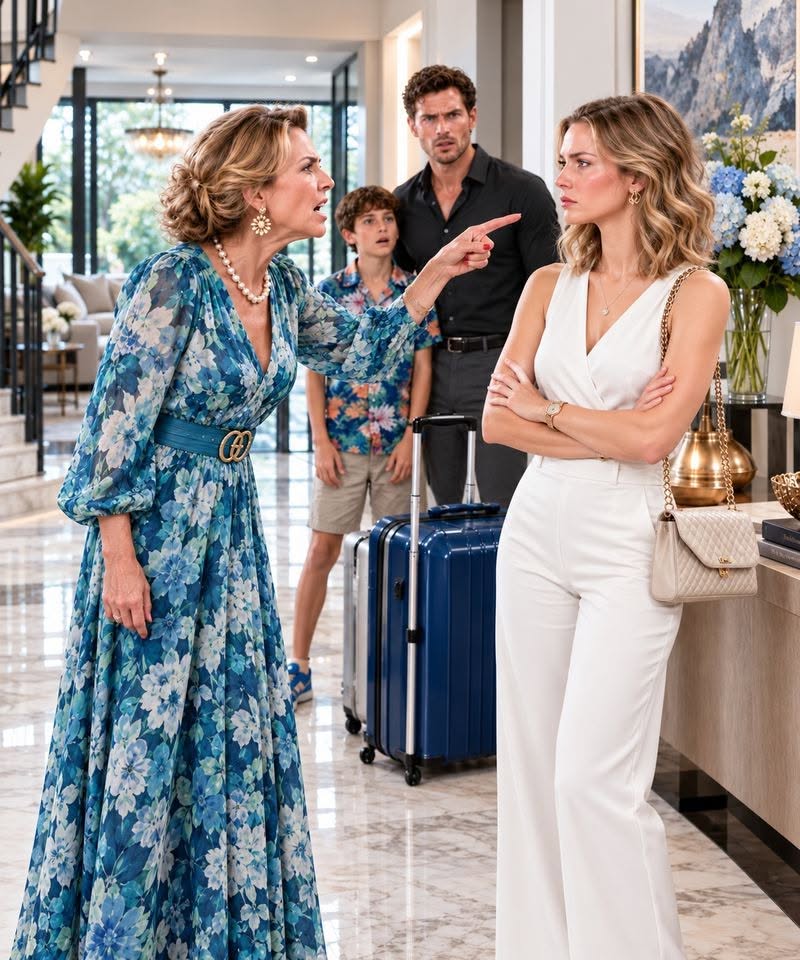
The first piece of popcorn landed on my shoulder. The second landed in my hair.
By the third handful, I could feel them settling in among my curls, warm and buttery, as if they’d signed a lease. Popcorn doesn’t fall out of hair like mine. It moves in.
On the screen, a hero in a red and blue suit swung between skyscrapers while the whole theater cheered. Behind me, a nine-year-old boy was laughing so hard he was coughing.
Beside me, my husband Owen was staring at the side of my head.
He plucked a kernel from my curls and held it up in the flickering light. He looked at it, then at my face. I’ve asked him what he saw there. He says he can’t remember. He only remembers something inside him, quiet for thirty-eight years, finally standing up.
He set the kernel on the armrest very carefully, like evidence.
“Stay here,” he said, and walked out.
Owen doesn’t walk out. Owen doesn’t do anything that might make anyone uncomfortable, even for a second.
To understand why this mattered, you have to understand my husband.
The Gentlest Man
Owen is six foot two and works construction. He can carry a sheet of drywall up a flight of stairs by himself. But he will do almost anything to avoid a disagreement.
On our third date, his steak arrived well done when he’d ordered it medium-rare. He ate all of it.
“It’s gray, Owen.”
“It’s fine. A little chewy, but fine.”
When the waiter asked how everything was, he said, “Great. Thank you.”
I thought it was sweet at first. It took me two years to see that it wasn’t kindness. It was fear.
In eight years of marriage, I’d watched him accept the wrong order at drive-throughs more times than I could count. He paid for a car repair he knew was inflated. When our neighbor built a fence a few feet onto our property, he said, “Well, it’s a nice fence.” When a promotion he’d earned went to someone newer, he said, “He probably needs it more than me.”
Whenever a voice got raised, Owen went quiet and still, and his thumb rubbed against the side of his finger, over and over.
One night I asked him why he let people walk over him.
“Because the alternative is worse,” he said.
“What’s the alternative?”
He looked at me, and I saw something old and frightened in his face.
“Being like my dad.”
Frank
Owen’s father, Frank, was big and loud, with a laugh that filled a room and a temper that emptied it. At the first barbecue I attended, he shouted at a grill that wouldn’t light. Owen just quietly picked up the lighter fluid.
After his wife passed away, Frank lived alone for two years. Then he began forgetting things: his keys, his lunch, then bigger things. He called Owen at three in the morning asking where his wife was. He left the stove on. One day he got lost driving to a store he’d visited for thirty years. The doctor said early-onset dementia, moving fast.
Owen’s sister lived far away and had “a hundred reasons.” So Frank moved in with us.
We turned the home office into his bedroom. We put a chime on the front door and hid the car keys. Some days he was nearly himself, watching old westerns and grumbling that they didn’t make them like they used to. Other days he didn’t know where he was, and he was frightened and angry.
Each time Frank’s voice rose, Owen would stand in the doorway with his arms at his sides, thumb rubbing his finger, and say softly, “Dad. It’s okay. You’re safe.”
We hadn’t been out alone together in seven months. Every plan had fallen through: a canceled visit, a bad afternoon, a caregiver’s phone call in a beach parking lot. Eventually we stopped trying.
One night in bed I asked, “If you could do one normal thing, what would it be?”
He thought for a long time. “Go to a movie. Sit in the dark. Eat bad popcorn. Not think about anything for two hours.”
“What movie?”
He smiled for the first time in days. “The new Spider-Man comes out in September.”
“You’re thirty-eight.”
“I’ve seen every one since I was a kid,” he said. “It was the one thing my dad and I did together that didn’t end badly. He’d buy me a large popcorn. He couldn’t lose his temper in a movie theater. It was the only place I felt safe with him.”
He stopped, as if he’d said too much. I took his hand.
“Then we’re going,” I said.
Opening Weekend
It took three weeks to arrange. I hired a retired nurse named Mrs. Pham, who had spent twenty years in memory care. She visited twice beforehand. When Frank called her “Doris,” his mother’s name, she didn’t correct him. She just asked, “Want to watch a western, Frank?”
I booked two reserved seats in row F, dead center. I bought Owen a Spider-Man T-shirt as a joke, and he wore it.
At the door he hesitated. “What if Dad wakes up and doesn’t know where he is?”
“Then Mrs. Pham handles it. Two hours, Owen. You’re not a caregiver tonight. You’re just a guy at a movie.”
He smiled. “Just a guy at a movie.”
The lobby smelled of butter, sugar, and old carpet. Owen breathed it in. “I love this smell.”
“It smells like feet.”
“It smells like freedom.”
We found our reclining seats. He put his feet up and sighed. “Oh, this is nice.” I rested my head on his shoulder.
“Thank you for getting us here,” he said.
The lights dimmed. A family sat down behind us in row G: a dad on a phone call, a mom texting, and a boy of about nine in a Spider-Man shirt, with light-up sneakers.
The Popcorn
Before the previews ended, something pushed against the back of my seat. Then again. Rhythmic, like he was keeping time to a song only he could hear.
I turned around politely. “Could you ask him to put his feet down?”
The mother rolled her eyes without looking up. The father sighed. “Ethan. Feet down.”
They stayed down for about three minutes.
Then the movie started, and so did the popcorn. Ethan laughed at everything, high and loud, and each time he laughed he flung a fistful toward his mouth. Half of it hit the floor. The other half came over my seat.
Owen picked kernels out of my hair and stacked them on his armrest. “You’ve got butter in your curls,” he whispered.
“I know.”
I asked again. “Please stop. It’s going in my hair.”
“He’s eating,” the father said, eyes on his phone.
“He’s missing his mouth by three feet.”
“He’s a child,” the mother snapped.
I turned back. I refused to spend our one night out in an argument. Owen needed this too much.
But the kicking got harder, especially during the quiet scenes. Thunk. Thunk. People in nearby rows began to turn and look. Something cold trickled down my neck. Soda.
Ethan wasn’t watching the movie. He was watching me, waiting to see what I’d do.
“Please,” I said, too tired to be polite. “Stop kicking my seat.”
“Can you just watch the movie?” the mother said.
“Three times you’ve been asked,” said a gray-haired man from row H. “He’s kicked my wife’s seat too.”
“Mind your own business,” the father replied.
Ethan kicked again, hard.
I didn’t expect anything from Owen. I knew what confrontation cost him. So I sat there with popcorn in my hair and blinked hard, because I was not going to cry at a superhero movie.
Owen picked out one more kernel and held it up in the light. His face changed. It wasn’t anger. It was quieter, like watching a door close, or open.
He put the kernel on the armrest.
“Stay here.”
Four Minutes
He was gone four minutes. I counted on my phone. Maybe he needed air, I thought. At home he sometimes sat in the garage in the dark just to breathe.
Then a flashlight beam cut through the dark. A very nervous teenage usher led the way, followed by a tall woman in a black blazer with a gold name tag. She walked like someone who had settled many disputes and won them all.
Behind her walked Owen, straight-backed, his hands steady.
“I’m Tamika, the manager tonight,” she said, calm and low. “We’ve had complaints from this row and the ones around it about kicking and food throwing.”
“We paid for these seats!” the father said.
“So did everyone here, sir. I’ll need your son to keep his feet down and his food in his lap.”
“Why don’t they move?” the father demanded, pointing at us.
Owen spoke, quietly and steadily.
“Because we’ve been trying to have one night out for seven months. My father has dementia and lives with us. We hired a nurse so we could be here. My wife asked you nicely three times. So, no. We’re not moving.”
The whole row went silent.
“That’s not my problem,” the father said.
“No,” Owen said. “But she is.” He nodded toward me, then toward Ethan. “And so is he.”
Tamika offered a refund or passes for another showing. “But I do need you to leave.”
Grumbling, the parents gathered their things. As they passed, Ethan glanced back. Not at me. At Owen. He didn’t look angry or embarrassed. He looked sad and a little scared.
Owen’s whole body went still.
“You were very clear,” Tamika told him. “Most people just yell at me in the lobby.”
Owen barely heard her. His thumb was rubbing his finger faster than I’d ever seen. “Did you see the boy’s face?” he said. “I’ll be right back.”
Ten seconds later, I followed him.
The Lobby
I heard the father’s voice before I saw him.
“—embarrassed me in front of everyone! Do you understand that?”
Ethan stood near the box office, tears on his cheeks. “I’m sorry, I’m sorry, I didn’t mean to—”
“You never think. That’s your whole problem.”
The father wasn’t hitting anyone, but his voice was harsh and cutting, and every word landed on a small boy who was shrinking. A few people watched. Nobody spoke.
Owen was standing fifteen feet away. I could see it in his face: he was nine years old again.
Then he walked forward.
“Hey,” he said gently. “Could we talk for a second?”
“You got us thrown out. Isn’t that enough?”
“I’m not here to fight,” Owen said. “I’m not going to yell. I just want to tell you something.”
The father crossed his arms but didn’t leave.
“When I was his age, my dad took me to the movies. It was the only place he didn’t shout at me, because everybody could hear. One night I spilled my soda on his shoes. An accident. He dragged me out to the parking lot and told me, in front of everyone, how worthless I was.”
The lobby was silent.
“A woman was getting into her car beside us. She looked right at me. Then she looked away and drove off. I’ve thought about her for twenty-nine years. I wanted so badly for her to say anything. Just ‘hey.'”
He looked at Ethan.
“So I’m saying it. Hey.”
For a long moment, nobody moved. The father’s jaw worked. His arms slowly fell to his sides.
“This is none of your business,” he said, but the fight had gone out of his voice.
“You’re right,” Owen said. “It isn’t.”
He crouched down to Ethan’s level and didn’t come any closer.
“You okay, buddy? I’m sorry you missed the movie. I could tell you loved it. You laughed at all the good parts.”
Ethan’s lip trembled.
“Kicking seats and throwing popcorn wasn’t okay,” Owen said. “But that doesn’t make you a bad kid. It means you did some not-okay things tonight. That’s different. I think maybe you were trying to get someone to notice you.”
Ethan nodded, and his face crumpled.
“They were fighting in the car,” he whispered. “And at the movie Dad was on his phone and Mom was on hers, and nobody was watching with me. I kept laughing so they’d look. When the lady turned around, that was the first time anybody looked at me all night.”
His mother put her phone away slowly, as if she’d forgotten how it worked.
“That’s a hard thing,” Owen said. “When nobody’s looking. I know exactly how that feels.”
Ethan wiped his eyes and pointed. “You have a Spider-Man shirt too.”
“My wife got it as a joke. I’m too old for it.”
“You’re not too old. My grandpa likes Spider-Man and he’s like a hundred.”
Owen laughed, and Ethan almost did.
His mother knelt on the sticky lobby floor and wrapped her arms around him. “I’m sorry, baby. I’m so sorry.”
“Brad,” she said quietly. “Let’s go home.”
The father stood awkwardly, then rested a hand on top of his son’s head. “Let’s go, bud,” he said, his voice rough.
At the glass doors, Ethan turned and waved. Owen waved back.
Owen’s hand, in mine, was shaking.
The Parking Lot
We didn’t finish the movie. In the car, Owen gripped the wheel, put his forehead down, and cried. Not quiet tears, but deep sobs from somewhere very old.
“It’s this parking lot,” he said at last. “The same theater. They renovated it, but it’s the same building. I recognized it when we pulled in. I didn’t want to ruin the night. I wanted to sit in the dark and have it be good, just once, in this place. I wanted to take it back.”
He wiped his face.
“And that kid had my face, Jenna. My exact face from when I was nine. I thought, if I do nothing, I’m that woman who looked away.”
“You did something.”
“I’ve spent my whole life afraid of being like my dad,” he said. “So I never said anything to anyone. But tonight I didn’t yell. I just said what was true, calmly. And it worked.” He shook his head. “You don’t have to be loud to stand up for somebody. I’m thirty-eight years old and I didn’t know that.”
I hugged him across the gearshift. “I’m so proud of you.”
“We didn’t even see the movie.”
“I don’t care about the movie.”
“You have popcorn in your hair,” he said into my neck.
“I know.”
He plucked a piece from my curls, held it up in the parking lot light, and ate it.
“Owen! That’s disgusting.”
“It’s buttery. Your hair made it better.”
We laughed together for the first time all night.
Frank’s Room
When we got home, Mrs. Pham looked up from her knitting. “He woke up about an hour ago asking for you, Owen. I told him you’d gone to the movies. He got quiet and said, ‘I used to take him to the movies.'”
Owen stood outside his father’s door for a long time. “I think I need to do this one alone.”
I watched through the crack. Frank sat propped up in bed in his old flannel pajamas, looking small. He’d once been such a big man.
“You went to the movies,” Frank said.
“Spider-Man.”
Frank smiled, softly. “We used to see those. You’d eat the whole popcorn yourself.”
Then he looked at his shaking hands. “I wasn’t always good to you, son. I forget a lot now, but I don’t forget that. I remember the parking lot. I don’t know why I was like that. I swore I’d never be like my old man. And then I was