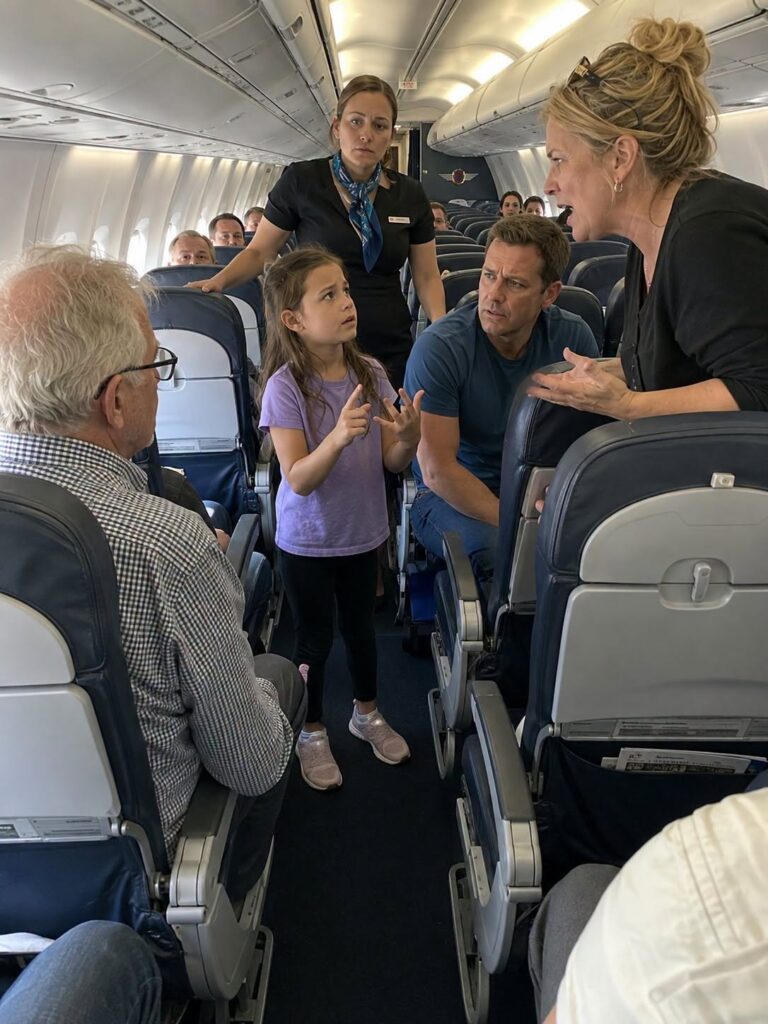
I was three hours into a red-eye flight from Chicago to London, half-asleep in my first-class seat, when the flight attendant’s voice came over the intercom asking if any medical professionals were on board.
An elderly man two rows behind me had collapsed, unresponsive, his wife’s panicked voice audible even over the cabin’s ambient noise. I unbuckled and moved toward them immediately, identifying myself to the flight attendant, Marisol, as a retired ICU nurse — thirty-one years of critical care experience before I’d stepped back from full-time hospital work five years earlier, a detail that, in that moment, mattered far more than anything else about who I was or what seat I happened to be sitting in.
The man, seventy-eight according to his wife, had a known cardiac history and had stopped breathing normally, pulse thready and irregular under my fingers as I checked it, working through the same rapid assessment I’d performed hundreds of times over three decades, muscle memory taking over more readily than I expected given how many years had passed since my last active shift.
I directed Marisol clearly: get the plane’s emergency medical kit, get the AED, ask if anyone else on board had relevant training who could help manage the growing crowd of understandably alarmed nearby passengers. A retired paramedic two rows up came forward as well, and between the two of us, we worked through stabilizing the man as best the situation allowed — positioning him properly, monitoring his breathing and pulse, preparing the AED in case it became necessary, all while the flight crew coordinated with ground-based medical support through the aircraft’s emergency communication system.
The man regained consciousness about six minutes into our efforts, disoriented but breathing steadily, his pulse settling into something closer to a normal rhythm, though clearly still concerning enough that the captain made the call to divert the flight to the nearest airport capable of handling the medical emergency properly rather than continuing on to London.
I stayed with him, monitoring his condition, until paramedics boarded following our emergency landing in Newfoundland, providing a clear, detailed handoff of everything we’d observed and done during the in-flight response, information that the ground medical team told me afterward had genuinely helped streamline his care once he reached the hospital.
What happened after the immediate crisis resolved is the part of this story that, I’ll admit, ended up getting more attention than the actual medical response itself, though I don’t think it should have.
Marisol, filling out the required incident report, asked for my full name and professional details for the airline’s records, and recognized my name from an unrelated context — I’d spent the last several years, since retiring from full-time nursing, serving on the board of a national patient-safety nonprofit, work that had occasionally put my name in trade publications and a couple of mainstream news pieces about hospital safety reform.
“Wait,” she said, “aren’t you the same person who testified before Congress about ICU staffing ratios last year?”
I was, in fact, that same person, though I hadn’t mentioned it during the emergency itself, because it had absolutely nothing to do with what the situation required in the moment. What mattered on that plane wasn’t my subsequent policy work or the modest public profile it had built. What mattered was thirty-one years of hands-on critical care experience, muscle memory that didn’t care whether I’d since become recognizable in a narrow professional advocacy circle.
I want to be honest that I noticed a subtle shift in how the flight crew treated me once that connection surfaced — a bit more deference, a slightly more attentive check-in during the remainder of our delayed journey to London after the diverted landing and subsequent medical clearance. I understood the impulse, but it also highlighted something I think matters more than the specific reveal itself: my actual value in that emergency had nothing to do with any public recognition I’d since accumulated. It came entirely from decades of unglamorous, hands-on clinical experience that would have been exactly as valuable if I’d been a complete unknown rather than someone whose name happened to ring a bell for one particular flight attendant.
The man I helped, whose name I later learned was Frank, recovered well according to a card his wife sent several weeks later, thanking the “wonderful retired nurse” who’d helped him on the flight, a letter that didn’t mention my subsequent congressional testimony or nonprofit work at all, because none of that had been relevant to what she’d actually witnessed that night.
I think about that flight now mostly in terms of Frank’s recovery, and the particular, familiar satisfaction of watching thirty-one years of training translate smoothly into an emergency response even five years removed from full-time practice. The recognition that came afterward was a strange, mostly irrelevant footnote — interesting to the flight crew, genuinely meaningless to what actually mattered in those six critical minutes.
What I’d want anyone reading this to take from it isn’t “you never know who might be sitting in seat 2A.” It’s that expertise built over decades doesn’t announce itself, doesn’t require a recognizable name or a public profile to be genuinely valuable in the moment it’s actually needed. Frank didn’t need a nonprofit board member helping him that night. He needed a nurse. That I happened to also be one other thing entirely was, and should remain, beside the point.